Scroll through enough Facebook ads, and you will see the same pitch: Search Engine Optimization (SEO) is dead, AI ate your traffic, and you better switch to something new.
It’s a great hook.
It’s also not quite true.
The 2026 data points to a different conclusion: SEO did not die. It expanded from ranking on Google into a broader strategy for being found wherever people search.
Google Isn’t Going Anywhere
Despite all the attention surrounding AI search, Google remains overwhelmingly dominant in traditional search. That means SEO is not dead. AI platforms such as ChatGPT and Perplexity are growing rapidly, but they are nowhere near replacing Google. What is changing much faster is what happens after someone searches.
The Click Is What’s Dying
Google’s AI Overviews are dramatically reducing organic clicks. An Ahrefs analysis of 300,000 keywords found that the presence of an AI Overview was associated with a 58% lower average click-through rate on the top-ranking page. Click here to see the Ahrefs blog.
Search Isn’t One Channel Anymore
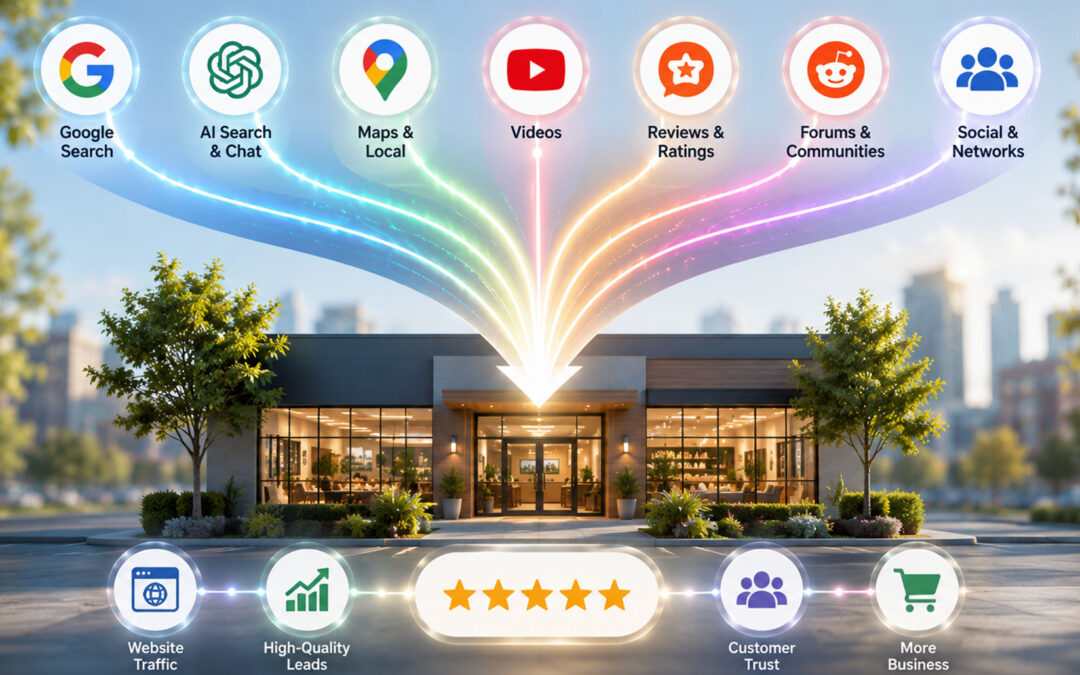
People have not stopped searching for accountants, contractors, restaurants, products, or local services. They are simply searching in more places. Businesses still need useful websites, strong content, recognizable expertise, and a good reputation. What is changing is the browser itself. It is becoming more like an information dashboard and a gateway to AI assistants, maps, reviews, social media, YouTube, Reddit, and other sources to research products and services for their homes and businesses—all from the same browser. SEO is not dead, but changed. The challenge for businesses is making sure they can be found and trusted across those different sources.
That does not mean every business needs to be everywhere. It means SEO needs to be viewed as a broader visibility strategy. If someone searches for what your company does—whether on Google, ChatGPT, YouTube, or another platform—your business should have a reasonable chance of appearing.
Getting Cited Is Becoming as Important as Getting Ranked
Traditional rankings still matter, but AI search places greater emphasis on authority, expertise, and content worth citing. Many of these signals reinforce what Google has emphasized for years: trustworthy, original, and useful information.
There is also an economic dimension. Google and other technology companies are investing enormous sums in the infrastructure required to power AI. At the same time, generative AI has made it remarkably cheap to produce thousands of pages of thin, repetitive content. That creates a fundamental challenge for search engines: how do you distinguish genuine expertise from an almost unlimited supply of inexpensive AI-generated content?
Trust signals provide part of the answer. Original research and proprietary data provide facts worth citing. Named experts and professional credentials establish who is behind the information, while reviews, forums, industry publications, and other independent mentions provide outside validation. Structured content and schema make those signals easier for search engines and AI systems to understand.
Anyone can generate 100 generic blog posts. It is much harder to manufacture years of experience, original research, customer reviews, professional credentials, independent mentions, and a strong reputation across the web. Companies that build that kind of authority are better positioned to be found in both traditional Google search and the AI systems increasingly influencing purchasing decisions.
What Businesses Should Do
The question is no longer, “Can we rank for this keyword?” Businesses should also ask whether Google and AI can clearly understand what they do, whether their websites demonstrate genuine expertise, whether they publish information worth citing, whether customers and independent sources discuss them elsewhere online, and whether people can find them beyond Google. Those questions increasingly define online visibility.
Marketing Prescriptions for the New Search Environment
The changing search landscape is exactly why Downs Digital developed its Prescription SEO approach. Traditional SEO focused heavily on rankings and keywords. Today, businesses also need the authority, expertise, original content, reviews, and a broader online presence to get discovered and trusted across Google, AI search, maps, social media, and other channels.
Downs Digital uses advanced AI tools, including ChatGPT and Claude, alongside traditional SEO and competitive research to analyze a company’s market at a depth that was not practical just a few years ago. We examine what the strongest competitors are doing, where opportunities exist, and which combination of website improvements, SEO, content, reviews, and digital visibility is most likely to produce results.
The result is not a generic SEO package. It is a marketing prescription based on the competitive environment of each business. The objective is straightforward: build the authority and visibility needed to be found, trusted, and ultimately chosen—whether the customer begins the search on Google, an AI assistant, a map, a review site, or somewhere else online.
The Facebook ads claiming SEO is dead are not entirely wrong. Something did die. They are just naming the wrong thing. Downs Digital welcomes the opportunity to analyze your competitive market and develop a Prescription SEO strategy for your business. Call us at 303-748-5851.
Frequently Asked Question
Is SEO dead in 2026?
No. SEO is changing rather than disappearing. Google remains a major source of online discovery, but customers increasingly search through AI assistants, YouTube, Reddit, social media, maps, reviews, and other sources. Modern SEO is becoming a broader strategy for making a business visible wherever potential customers search.
What is Prescription SEO?
Prescription SEO is Downs Digital Marketing’s customized approach to improving online visibility. Instead of applying the same SEO formula to every business, we use competitive research, performance data, and advanced AI tools to analyze your market and identify the specific combination of website improvements, content, SEO, reviews, and digital marketing most likely to produce results. The goal is to help your business get found, trusted, and chosen across Google, AI search, maps, and other places customers increasingly use to find products and services.
How can a business appear in ChatGPT and other AI search results?
There is no guaranteed way to appear in an AI answer. Businesses can improve their chances by publishing accurate, original content, clearly demonstrating expertise, maintaining a strong website, earning reviews and independent mentions, and making their information easy for search engines and AI systems to understand.
Should businesses focus on Google SEO or AI search?
Both. Google remains important, while AI-assisted search is growing rapidly. Rather than treating them as separate strategies, businesses should build a strong overall web presence that spans traditional search, AI assistants, reviews, social media, YouTube, Reddit, and other places where customers research companies.
Sources
Google: Optimizing for Generative AI Search
Google: AI Features and Your Website
Ahrefs: Updated AI Overview CTR Study
Similarweb: Zero-Click Searches and AI Overviews
Semrush: ChatGPT Traffic AnalysisGoogle: Creating Helpful, Reliable, People-First Content