

Gothenburg and Denver are similar enough in population to make a useful comparison—roughly 600,000 people in Gothenburg versus about 700,000 in Denver. More important is where the two cities sit in padel’s market cycle. Gothenburg and Sweden have already experienced the entire arc: introduction, explosive growth, overbuilding, correction, and stabilization. Denver is just beginning the cycle, with six clubs and roughly 31 courts expected by this fall.
One number needs clarification. Denver’s 31 refers to courts. The Gothenburg metro has roughly 31 padel venues, several with 10, 17 or even 20 courts apiece. The seven Gothenburg clubs examined here alone account for 58 courts, and the total market is close to 100. Denver remains much earlier in its buildout.
Padel Explodes in Gothenburg
Padel arrived in Sweden in the late 1990s but remained a small sport for nearly two decades. Then growth accelerated. Sweden went from 41 courts in 2015 to 157 in 2017. In Gothenburg, an important milestone came in 2018 when GLTK, one of the city’s established tennis clubs, converted an old tennis hall into four indoor padel courts. Dedicated facilities followed, including Padel Arena Frihamnen and Städhem Padel Arena in 2019.
Then COVID arrived, and the market detonated.
Unique Swedish padel bookers increased from about 170,000 in 2019 to 410,000 in 2020 and 540,000 in 2021. For comparison, 1.07 million Americans played padel at least once in 2025, according to the Sports & Fitness Industry Association, although only about 238,000 played eight or more times. Sweden’s court inventory jumped from roughly 560 in 2019 to 1,600 in 2020 and 3,500 in 2021. Gothenburg participated fully in the boom, adding large new facilities such as Maxipadel Arena and Bon Padel Arena.
By early 2022, the correction had begun. Courts had expanded much faster than the player base. Booked court hours declined from about 5.8 million in 2021 to 5.29 million in 2022, while unique bookers fell from roughly 540,000 to 421,000.
By the end of 2024, more than 100 Swedish facilities had closed, and roughly 90 padel companies had filed for bankruptcy. We Are Padel, backed by private equity, closed 50 of its 63 clubs in Sweden. Estimates put the capital destroyed during Sweden’s padel boom-and-bust at nearly €500 million, or over half a billion dollars.
Gothenburg had its share of casualties. Acapulco Padel & Club in Hisings Backa and Acapulco Sport Event Arena in Partille both closed in 2024. Padel Center Göteborg AB, Gothenburg’s first indoor padel center, closed in 2023. We Are Padel Kungälv, a 21-court facility, went bankrupt that same year. Åby Padel opened in 2021 with 25 courts, later reduced its operation to seven, and closed completely last year.
Why Did Padel Clubs Fail?
Several analyses of Sweden’s padel crash point to the same causes, but perhaps the most useful explanation came from a Gothenburg-area operator who survived it.
Several analyses of Sweden’s padel crash point to the same causes, but perhaps the most useful explanation came from a Gothenburg-area operator who survived it.
In 2022, Behnam Rezaei, owner of Padelfabriken, summarized his view: “It takes more than just courts for facilities to survive.” He argued that successful clubs need programming, tournaments, activities, a sense of community, and continuous interaction with customers. Padel could no longer be treated as a real estate business where an operator leased a large building, installed courts, and collected hourly rental fees.
On top of the optimistic occupancy assumptions, many of these clubs carried substantial debt and had high fixed costs. The energy-price shock following Russia’s invasion of Ukraine made large indoor facilities even more expensive to operate. Public financial support may also have encouraged additional construction just as the market was becoming oversupplied.
The customer base was another problem. Sweden’s boom depended heavily on enthusiastic, financially secure adults. That group could fuel rapid growth but could not indefinitely support thousands of new courts. Sustainable growth required participation from juniors, women, families, beginners, and corporate groups.
Sweden’s crash had two primary causes. The first was structural: too many courts, too much capital, and too many fixed costs. The second was operational: too many facilities behaved primarily as court-rental businesses. The survivors increasingly competed on programming, coaching, community, retention, and customer experience.
Gothenburg’s Second-Generation Padel Market
The correction did not mean padel disappeared. By 2024, the International Padel Federation ranked Sweden among the world’s largest padel markets, with an estimated 600,000 amateur players. What changed was the business model.
Gothenburg’s surviving clubs increasingly rely on coaching, leagues, organized activities, and amenities that turn occasional court renters into recurring customers. The market moved from building courts to building relationships.
Bon Padel Arena is the clearest example. Its 20 courts are supported by a membership model that includes off-peak playing benefits, gym access, lunchtime padel and member activities. The facility also includes co-working space, a restaurant, conference facilities, a sauna, a cold plunge, and the Bon Business network. Its proposition is essentially: don’t just play here; make this your club.
Padel Arena Frihamnen emphasizes training and player development. Its academy has more than 180 players training every week, supported by junior programs, lessons and leagues. It creates a progression from beginner to instruction, competition and long-term membership. Rather than simply competing for existing players, Frihamnen has built a system for creating new ones.
Mölndal Padel competes on programming and community, offering more than 35 organized activities each week along with extensive league play. Its strength is simple: there is almost always something to play and somebody to play with.
Other clubs occupy distinct niches. Maxipadel Arena emphasizes corporate events and business networking. Östermalmshallen combines padel with a restaurant, sauna and golf studio. Best Padel offers a premium playing environment with a gym, golf simulator and conference facilities, while Pata Padel differentiates itself through outdoor play.
There is no single winning club model. What the survivors have in common is that they offer customers more than access to courts and an online reservation system.
What Does Gothenburg Tell Us About Denver?
Denver is nowhere near Gothenburg’s level of overbuilding. Roughly 31 courts in a metro area Denver’s size still represents a developing market. Denver’s larger challenge is awareness. Denver’s biggest challenge today may not be court supply, but building a large enough player base to support it.
Sweden entered its boom with years of exposure to padel through Spain and a strong racquet-sports culture. The United States is starting from a much smaller base of awareness. Denver players also have an unusually large number of alternatives competing for their leisure time, from tennis and pickleball to golf, skiing, cycling and hiking.
The lesson from Gothenburg is straightforward: building courts creates capacity; it does not create a market. Denver clubs need to introduce people to padel, teach them to play, connect them with other players and give them reasons to return. Community, programming, instruction, customer experience and digital visibility all need to develop alongside the facilities.
Gothenburg learned this after a costly market correction. Denver has the opportunity to learn it beforehand.
Digital Marketing Has a Different Job in Denver
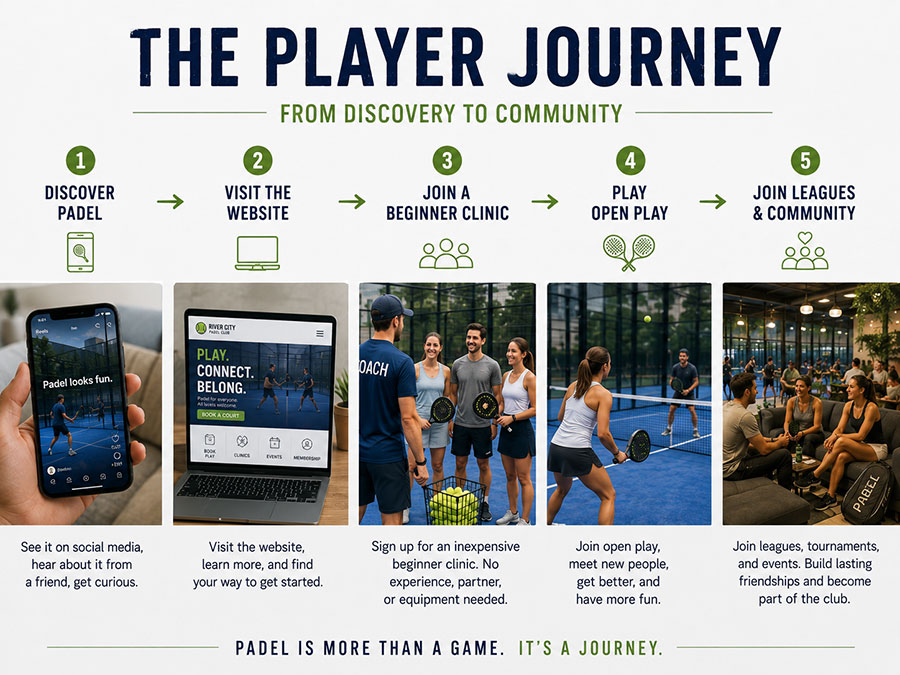
Most Denver clubs are building their Instagram and Facebook presence, which makes sense for a visual and social sport. But social media can create awareness without necessarily creating players. Someone may enjoy watching padel and still not know how to get started.
That is where the rest of the digital marketing mix matters. Google and AI search, YouTube and educational content help people discover and understand the sport, while the website turns that interest into action. It should make it easy to learn the basics, book a court, find lessons and events, connect with other players, and, most importantly, sign up for an inexpensive beginner clinic that requires no experience, partner, or equipment. Social media creates interest; the website helps turn that interest into a first padel experience.
- Social media creates awareness.
- Content provides education.
- Search generates discovery.
- The website converts interest into a first visit.
- Email, coaching, open play and leagues turn beginners into regular players.
Gothenburg’s surviving clubs learned that courts alone do not create sustainable businesses. Denver faces an additional challenge: its clubs must first develop many of the players they hope to retain. The real measure of digital marketing success is how many non-players become regular players.
Where Downs Digital Fits
Downs Digital brings more than 25 years of experience in competitive business-to-consumer markets to this challenge. The opportunity is not simply about generating more traffic, followers, or impressions, but about understanding how digital marketing can help more people discover padel, try it, and become regular players. For Denver’s padel clubs, growing the player base may ultimately matter more than competing for existing players.
Let’s talk about how digital marketing can help introduce more people to the sport and turn first-time players into regulars.
Call Downs Digital Marketing at 303-748-5851.
Frequently Asked Question
Can a padel club rely on social media alone to build its web presence in a market that is just beginning in Denver?
Probably not. Instagram and Facebook are excellent for creating awareness because padel is visual and social. But followers and views do not necessarily become players. Denver clubs also need search visibility, educational content, a useful website, video and follow-up marketing that help newcomers understand the sport and try it.
What should a Denver padel club’s website accomplish?
The website should educate newcomers and turn curiosity into action. Visitors should quickly understand what padel is, how to get started and what their first experience will involve. Signing up for a beginner clinic, lessons, open play and events should be simple.
Why is educational content important for padel clubs?
Most Denver residents still know relatively little about padel. Content answering questions such as “What is padel?”, “Padel vs. pickleball,” “Is padel difficult to learn?” and “Do I need a partner?” removes barriers to trying the sport and gives clubs useful material for search, social media and video.
How important is blogging in creating awareness about padel in Denver?
Blogging builds awareness while improving visibility in Google and AI search. Useful articles can introduce newcomers to padel and answer the questions that keep them from trying it. Unlike social posts that quickly disappear, a good blog can attract and educate potential players for months or years.