
What began on a cliffside estate in Acapulco has become one of the fastest-growing sports on the planet, and Denver is now part of that story.
 If you've noticed a strange new court popping up at your gym or racquet club lately — glass walls, wire mesh, a net lower than tennis, and four people laughing their way through a rally — you've spotted padel. It feels like the newest thing in American sports right now, but the game itself is more than half a century old. Its arrival in Denver is really the latest chapter in a story that started on a Mexican cliffside, took a 25-year detour before it reached the United States at all, and has spent the last five years compounding faster than almost anyone in the sport predicted.
An Argentine Model, a Cliffside Estate, and a Man Who Hated Chasing Balls
Padel's origin story starts in the late 1960s in Acapulco, Mexico, in the hillside neighborhood of Las Brisas — at the time a favorite retreat of Hollywood stars and international jetsetters. A wealthy Mexican businessman named Enrique Corcuera wanted a tennis court at his cliffside home but didn't have room for a full-sized one. So he built a smaller court instead, and, drawing on a Basque wall-ball game called pelota paleta that he'd played as a child in Europe, he had it enclosed on all sides. As his wife Viviana — an Argentine model who had been crowned Miss Argentina in 1964 — later told padel historians, Corcuera's reasoning was simple: he didn't want to spend his time chasing balls off a cliffside into the ocean below.
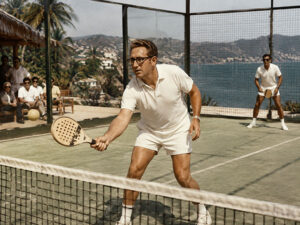
That backyard court, originally nicknamed "Tennis Corcuera," became a magnet for the international crowd passing through Acapulco. Regulars included a young Henry Kissinger (who insisted on 8 a.m. matches no matter how late the rest of the group had been out the night before) and Prince Alfonso of Hohenlohe-Langenburg, a Spanish-born businessman who spent his summers at Corcuera's estate. In 1974, Prince Alfonso built two courts of his own at the Marbella Club Hotel on Spain's Costa del Sol, planting the seed for what would become Spain's obsession with the sport. A year later, Argentine visitor Julio Menditeguy brought padel home to Buenos Aires, helping establish it at clubs like Club Tortugas. Spain and Argentina spent the next fifteen years quietly building the sport into a mainstream pastime, culminating in the founding of the International Padel Federation (FIP) in Madrid in 1991 and the first official World Padel Championship the following year.
A Quarter-Century Head Start Nobody in America Noticed
While padel was becoming a fixture of Spanish and Argentine sporting life through the 1980s, it barely registered in the United States. The first American padel court wasn't built until 1994, at The Houstonian Club in Houston, Texas — the result of an unlikely partnership between an Argentine padel enthusiast named Felipe Arnold and a Houston businessman (and former Mr. Texas bodybuilder) named Ed Thompson. The two assembled the first-ever U.S. national team for a 1993 exhibition in Acapulco, made up almost entirely of local tennis pros who had never touched a padel racquet, then imported the very glass-and-steel court used in that exhibition to Houston's front lawn the following spring. Canada actually beat the U.S. to the punch by a couple of years, with Calgary businessman Bill Stamile building the country's first court in 1992.
From there, growth was a slow trickle rather than a wave. Scattered courts appeared through the 1990s and 2000s — Martha's Vineyard, Chattanooga, Los Angeles — but it took until 2016 for the U.S. to get its first serious dedicated padel club, Wynwood Padel Club in Miami. Miami turned out to be the spark: a small circle of enthusiasts, including a French former tennis pro named Nalle Grinda and an investor named Wayne Boich (who would go on to found Reserve Padel, now operating in Miami and New York), started organizing tournaments and flying in European pros for exhibitions. That handful of Pro-Am events is widely credited with generating the momentum that turned Miami into the country's first real padel hub — and from there, the sport crept into Houston, Dallas, Oklahoma City, and a scattering of private clubs elsewhere. Even so, by the eve of the COVID-19 pandemic, the entire United States was still home to only a few dozen padel courts.
Then Everything Changed
What happened next is the part of the story most players joining today never see: in the six years since 2020, the U.S. padel court count went from a few dozen to well over a thousand, with new clubs opening most weeks. Padel checked every box a post-pandemic America was suddenly looking for — a doubles-only, highly social sport that's dramatically easier on aging joints than tennis or squash, visually built for Instagram and TikTok, and, per FIP's 2025 World Padel Report, still the fastest-growing racquet sport on the planet, now played by more than 35 million people across over 150 countries.
And by most measures, the U.S. is still near the very start of that curve. Despite the recent building boom, America has roughly 1,500 courts and an estimated 250,000 players — a rounding error next to Spain's 17,000-plus courts and 6.2 million players, or even the Netherlands' 3,500 courts serving a country a fraction of America's size. Simple back-of-envelope math on that gap is what has investors so animated: if the U.S. eventually reached France's per-capita court density, it would support more than 21,000 courts; at Italy's density, closer to 60,000. Industry analysis from Playtomic's 2026 Global Padel Report frames the U.S. as exactly that — a high-potential but structurally constrained market, where growth is real but gated by a few specific frictions: complex zoning and permitting that slows new construction, high import costs for courts and equipment, and, outside of the coastal hubs that got there first, simple lack of public awareness that the sport even exists. The same report also points to the mechanism that's quietly solving the awareness and space problems at once: tennis-club adoption, where existing racquet facilities repurpose or add padel rather than waiting on new ground-up construction — exactly the playbook already at work across Denver.
Denver's Moment Has Arrived
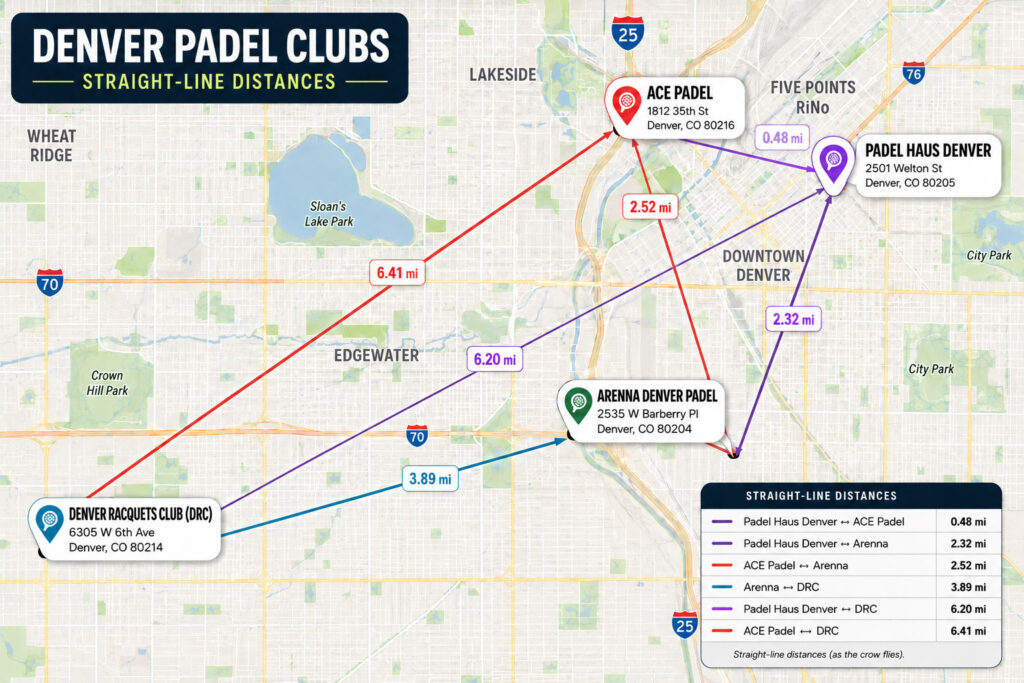
Denver offers a fascinating snapshot of where the American padel market is heading. An unusual number of new clubs have converged on the city within roughly the same twenty-four-month period, creating one of the country's most competitive emerging padel markets. Parker Racquet Club and Denver Racquets Club introduced padel by expanding existing tennis facilities, while Racket Social Club built a hybrid model centered on padel with pickleball alongside it. In 2026, Denver welcomed two dedicated padel clubs—Arenna Denver Padel and Padel Haus—and later this year ACE Padel will open inside a converted brewery building in RiNo.
Denver's rapid expansion mirrors broader national trends. Across the United States, padel is increasingly growing through adaptive reuse rather than new construction, with tennis clubs, warehouses, and industrial buildings being converted into courts. That's especially true in colder-weather markets, where indoor facilities have become the preferred model. Colorado already ranks among the nation's most indoor-oriented padel markets, making Denver well positioned for year-round play.
The pace of Denver's growth is remarkable when viewed in a national context. As of mid-2025, Colorado, Idaho, and Nevada together accounted for just fourteen padel courts after California was separated into its own category. Denver alone is now on pace to approach that total within a single metropolitan area.
Why Downs Digital
*Sources:
Padel For Dummies (Wiley)
FIP World Padel Report 2025
Playtomic Global Padel Report 2026
Misitrano Consulting, U.S. Padel Industry Report 2025.