In the last month, Downs Digital has gotten to know two young sports entrepreneurs. We respect them both. One is a civil engineer, and the other has an MBA. Both are passionate about a particular racquet sport, and both are taking a social-media-dominated approach to marketing their businesses. As a marketing professional, that got me thinking.
They are right about one thing: things are changing.
For years, the basic digital marketing strategy for business-to-consumer companies was fairly straightforward: get found online and drive people to the company website. Social media, Google, YouTube, directories, and email helped build awareness. Still, the website was usually where prospective customers learned more about the company, evaluated its credibility, and ultimately became leads or customers.
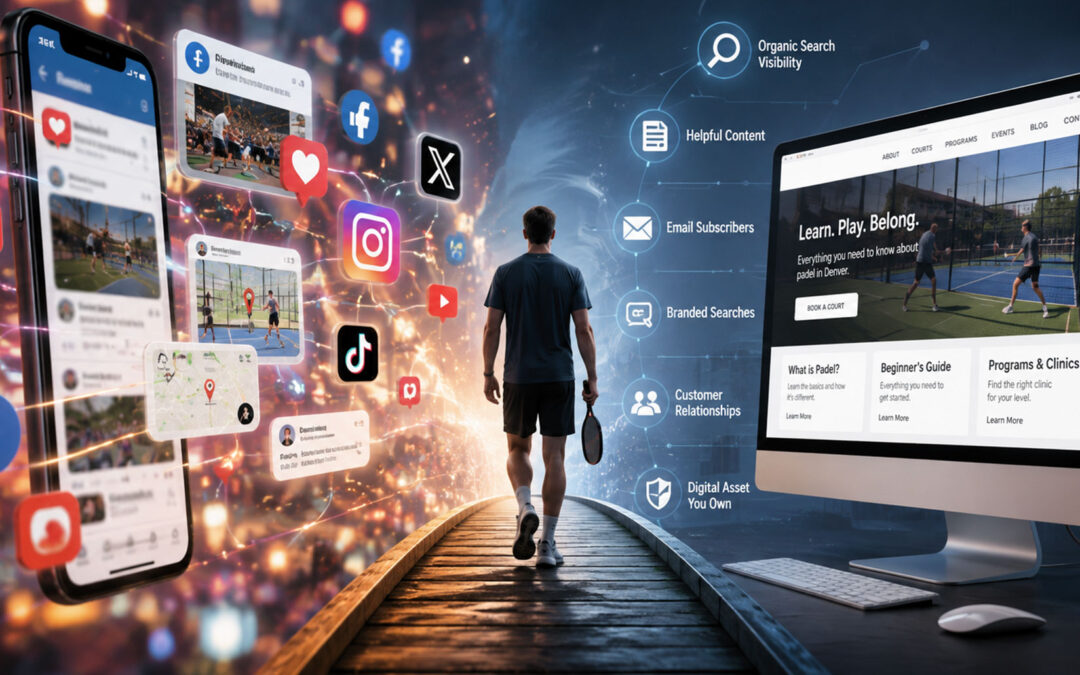
Today, Google, social media, AI search engines, maps, review sites, and reservation platforms increasingly allow consumers to discover and interact with businesses without ever visiting the company's website. The traditional "click economy," where success was measured largely by website traffic, is giving way to a broader discovery economy in which consumers may encounter a business several times online before ever reaching its domain.
Business Websites Are Not Obsolete—Their Role Is Changing
For years, Downs Digital Marketing has used Facebook, Instagram, LinkedIn, YouTube, and other social platforms as part of our clients' broader web marketing strategies. The objective was not necessarily to make the sale on social media. These channels distributed content, created awareness, generated engagement, and grew the brand. The website was often where that interest converted into a lead.
When we reviewed leads and sales for clients over the last 15 years, relatively few customers identified Facebook or Instagram as the source that ultimately generated the sale. Far more cited "Google" or "the web." That does not mean social media was not involved. A prospect may have seen a Facebook post, encountered the company several times, searched its name on Google, read reviews, visited the website, and finally submitted a form or called. Social media contributed to the journey, but the website was often where interest became business.
Rented Audience Or Digital Asset?
There is also an important distinction between the audience a company reaches and the assets it owns. A company may have thousands of Instagram followers, but Instagram controls access to those followers. The business does not control the algorithm, or what the platform will look like five years from now. The audience has value, but it exists largely on someone else's digital property. In other words, it is rented.
A website is different. A strong website can educate customers, demonstrate expertise, answer buying questions, capture email addresses, generate leads, collect first-party data, and move visitors toward a purchase. Over time, useful content, search rankings, backlinks, branded searches, direct traffic, and customer relationships can accumulate into something a competitor cannot quickly reproduce.
Organic search adds another advantage. Unlike paid advertising, where traffic generally stops when the budget stops, successful website content can continue generating visitors, leads, and sales long after the original investment. In the long term, organic search can be one of the most economical ways to market a business online—but it takes time and money to build.
There Is Another Side to the Argument
Consumers no longer necessarily need to visit a website to interact with a business. They can discover a restaurant on Instagram, read its Google reviews, check the menu, get directions, and make a reservation without ever visiting the restaurant's website. Someone can discover a local service company through Google Maps, call directly from the listing, or watch a company's videos on YouTube or TikTok for months before becoming a customer.
Social media has therefore become much more important. Younger entrepreneurs understand this particularly well because they grew up with it. Creating videos, sharing content, interacting with customers, and building communities comes naturally to them. An entrepreneur who builds an engaged audience of thousands of followers has created something genuinely valuable.
The younger entrepreneurs may be onto something.
It Doesn't Have to Be Social Media Versus the Website
The better strategy is to recognize what each channel does best.
- Social media creates attention quickly;
- Google captures people actively searching for a product or service;
- YouTube demonstrates expertise;
- Google Maps connects local customers with businesses;
- AI platforms introduce companies during research and discovery,
- Reservation platforms make transactions easier; and
- A website provides something different: a permanent digital home for the business.
The opportunity is not to convince social-first entrepreneurs to abandon what they are doing. It is about taking what they are already doing well and making it more valuable. Social media can produce attention today while authoritative website content builds search visibility and value over time. There is no longer a single funnel. However, business websites have become hubs rather than necessarily being the first or last stop.
Welcome to the Discovery Economy
For years, digital marketing was about generating the click: rank on Google, earn the click, bring the visitor to the website, and convert the visitor. Now businesses also need to think about being discovered. Google itself appears to recognize this change. In 2026, Google expanded Search Console beyond its traditional focus on websites, introducing Platform properties that provide information about how verified content from supported social and video platforms—including Instagram, TikTok, X, and YouTube—performs when it appears across Google Search, Discover, and Google News.
That is significant because Google Search Console has traditionally been one of the most useful tools for understanding organic website performance. Now it provides another piece of the customer journey by showing how some content published outside a company's website is being discovered through Google's ecosystem.
The question is no longer, "How many people clicked through to our website?" Increasingly, businesses need to ask, "Where are people discovering us, what content is creating that visibility, and how do we turn that attention into a customer relationship?" Google Search Console can help answer those questions, which is why businesses with an active online presence should be using it.
What Denver's Emerging Padel Market Can Teach Us
Padel typically sits on simmer when it first arrives in a city, then after several years it starts to boil. By this fall, Denver is expected to have six clubs with 31 courts, including four within six miles of downtown. The bigger opportunity is not simply competing for existing padel players. It is educating Denver's much larger tennis and pickleball population and getting them to try the sport.
Social media is ideal for creating that initial excitement because padel is highly visual. But once interest is created, prospective players have questions: What is padel? How is it different from tennis or pickleball? Do I need a partner or equipment? Where can a beginner play?
Authoritative website content can answer those questions while simultaneously building long-term visibility with Google and AI. The club that combines social media's immediate reach with an owned library of useful educational content can build both an audience and a digital asset.
The competitive opportunity is not simply to win Denver's existing padel players. It is to create Denver's next 1,000 players—and become the club they associate with the sport.
Downs Digital is willing to bet a five-page WordPress website that the dual strategy will outperform social media alone in Denver's emerging padel market. Call 303-748-5851 for details.