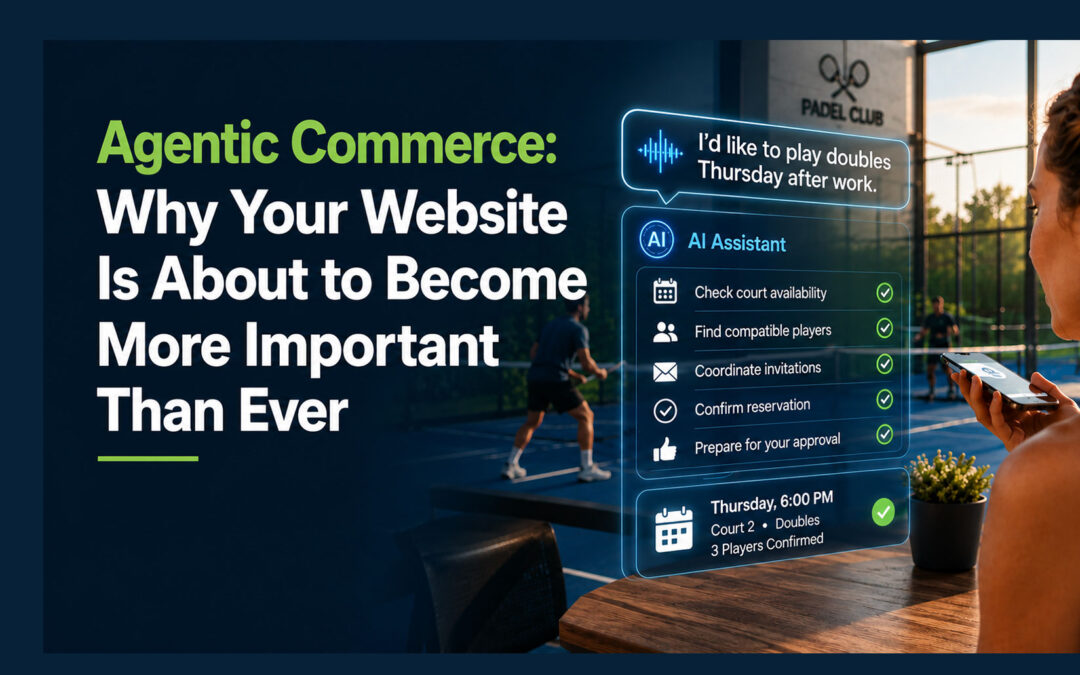
Imagine a racquet club where members no longer browse reservation calendars or search for available courts. Instead, they tell an AI assistant, "I'd like to play doubles Thursday after work." Behind the scenes, the AI checks court availability, identifies compatible players, coordinates invitations, confirms reservations, and presents the completed plan for the member's approval. The member experiences a simple conversation while multiple business systems work together seamlessly in the background.
For the past 25 years, businesses have optimized their websites to help customers find them. Soon, they may need to optimize their websites so AI can find—and recommend—them.
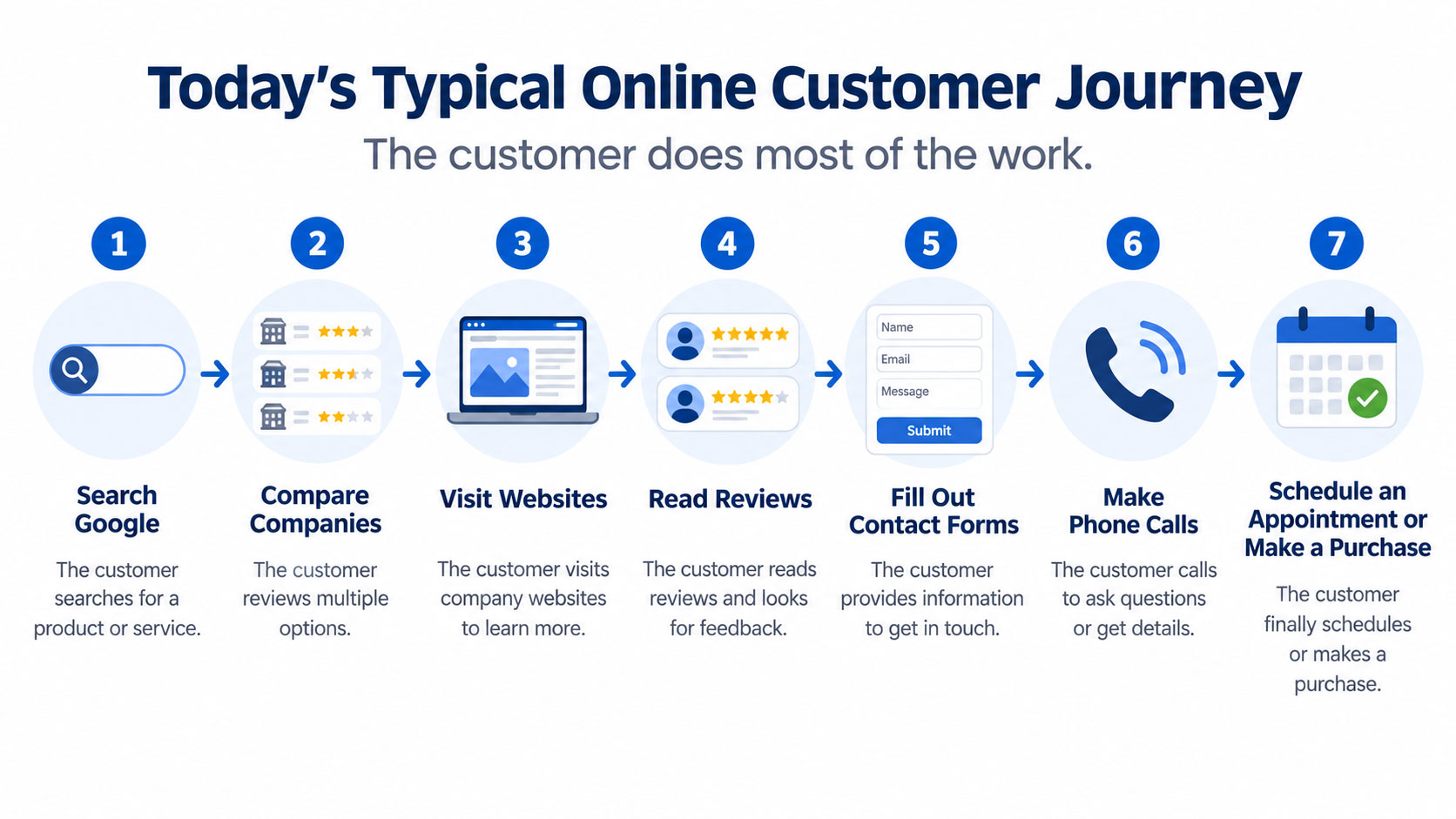
Today, the typical online customer journey is familiar. Someone searches Google, compares companies, visits websites, reads reviews, fills out contact forms, makes phone calls, and eventually schedules an appointment or makes a purchase. The customer does most of the work.
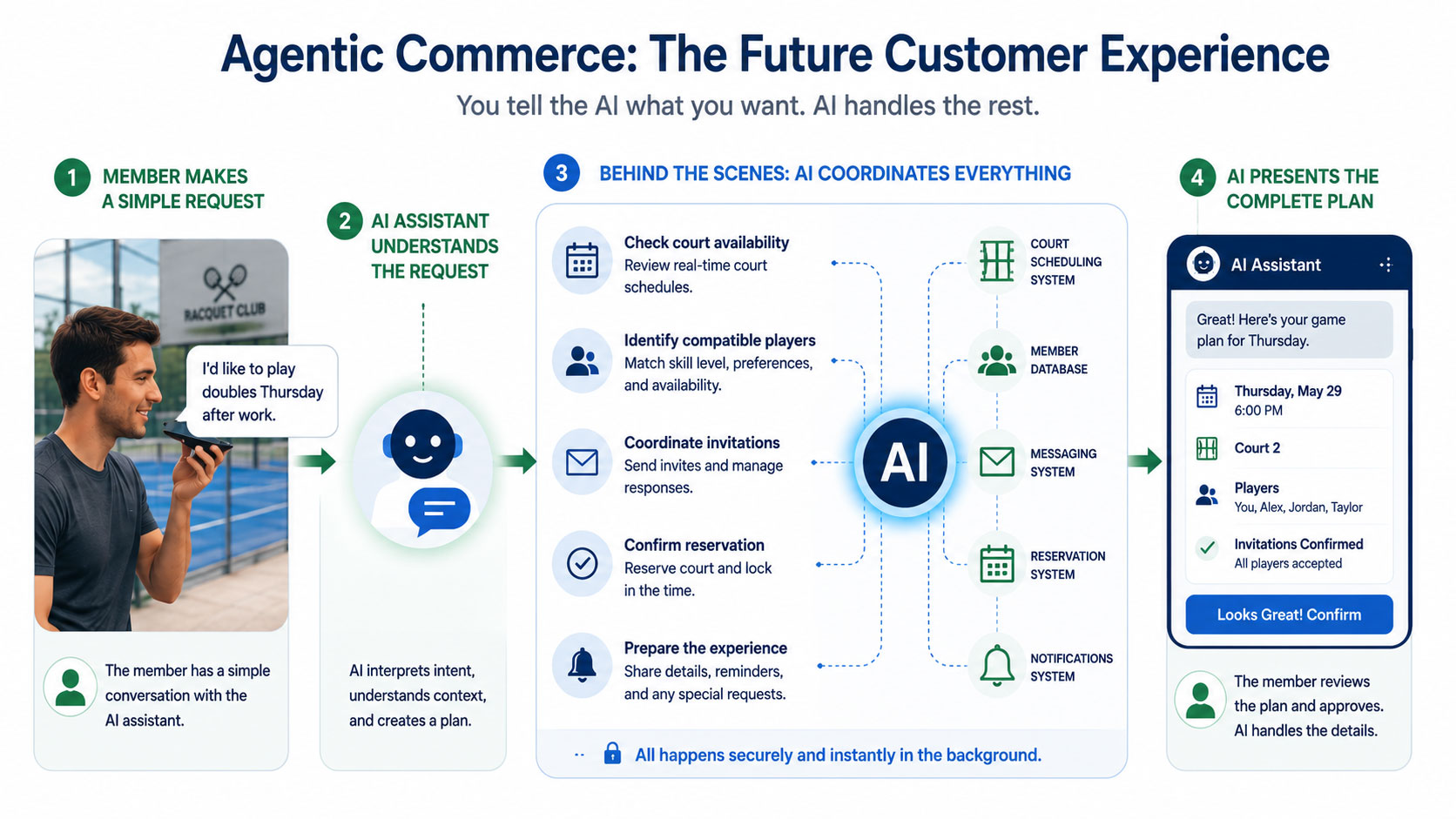
Artificial intelligence is beginning to change that process. Millions of people already supplement Google searches with AI tools such as ChatGPT and Gemini. The next step is agentic commerce—AI assistants that don't just answer questions, but complete real-world tasks on a customer's behalf.
Instead of presenting a list of websites, AI will increasingly identify qualified businesses, compare options, coordinate schedules, and recommend the best choice. For local businesses, this shift could be as significant as Google's introduction of web search more than 25 years ago.
Agentic commerce may still be several years away, but businesses should begin preparing today. The websites, content, and technology platforms they invest in now will determine how easily they can adapt as conversational and agentic AI become part of everyday commerce.
Will AI Replace Websites?
One of the biggest misconceptions about AI is that it will replace websites. Downs Digital believes exactly the opposite. AI depends on accurate, well-organized information to understand businesses and recommend them with confidence. For most organizations, that information comes directly from their website. As AI becomes more capable, the website becomes less like a digital brochure and more like a trusted knowledge base.
Before an AI assistant can recommend a business, it needs to understand the company and the products and services it provides, where it operates, define its differentiators, and explain why customers should trust it. For most businesses, that information comes directly from their website.
A website is no longer just a digital brochure. It is becoming the knowledge base that powers both search engines and AI assistants. The businesses that invest in building that knowledge base today will be best positioned to benefit from tomorrow's AI-driven customer experiences. Every service page, blog article, case study, customer testimonial, video, and frequently asked question helps build a richer understanding of a business. Companies that consistently publish high-quality educational content give AI far more information.
Content Is Still King
Content marketing is the practice of creating and publishing valuable digital content that attracts, educates, and builds trust with potential customers, ultimately encouraging them to choose a business. For years, Downs Digital has told its website development customers that the businesses that perform best online are the ones that educate their customers. A tree service company should not only talk about tree removal—it should explain how to identify tree diseases, prepare trees for winter, recognize storm damage, and understand proper pruning techniques. A property management company should not simply promote its services—it should answer questions about rental laws, tenant screening, lease renewals, and market trends. A racquet club should not just advertise memberships—it should teach people how to play, explain the differences between tennis, pickleball, and padel, introduce beginners to the sport, and build a sense of community. Educational content builds trust and attracts web users because it gives search engines and AI systems more reasons to recommend a business.
Closed and Open Source Development Platforms: What Is the Difference?
If websites become the knowledge base behind AI recommendations, the technology used to build those websites becomes more important. Businesses should ask not only "Which platform is easiest today?" but "Which platform will best support my digital strategy over the next five years or more?"
WordPress is an open-source website platform built on open web standards. Because a single company does not control it, businesses have the flexibility to customize, expand, and migrate their websites as their needs evolve. Like the Internet itself, WordPress benefits from an open ecosystem that encourages innovation, competition, and long-term stability.
Wix and Squarespace take a different approach. They are proprietary website platforms owned and operated by a single company. They simplify website development and are excellent choices for many small businesses, but they provide less flexibility and control as a company's digital marketing strategy becomes more sophisticated.
This flexibility helps explain why WordPress powers roughly 60% to 63% of all CMS-based websites worldwide, while Wix accounts for about 2.5% to 4.5% and Squarespace about 1.8% to 3.4%.
As businesses invest more in content marketing and search visibility, WordPress provides greater control over search engine optimization (SEO). Plugins such as Yoast SEO and Rank Math help manage metadata, internal linking, readability, keyword optimization, and schema markup across an expanding website, making it easier to maintain SEO best practices over time.
In a nutshell, a well-built Wix or Squarespace website can rank very well. Downs Digital builds Squarespace websites, and it is an excellent platform for many businesses. However, for organizations competing in highly competitive markets or planning significant long-term investments in content marketing and SEO, we generally recommend WordPress because it offers greater flexibility, scalability, and control as their websites grow.
Phased Approach
Downs Digital sees a practical three-phase roadmap.
Phase 1: Build a strong digital foundation with a modern website, a comprehensive SEO strategy, and an ongoing commitment to content marketing. The website must be compatible with customer relationship management software or reservation platforms of choice.
Phase 2: A sound digital foundation allows them to add functionality as needed. WordPress has thousands of plugins that do just that. Because WordPress has such a large market share, most software companies develop WordPress integrations first.
Phase 3: The third phase introduces conversational AI that understands customer intent and coordinates those systems to simplify appointments, reservations, customer service, and ongoing engagement.
Phase one is now. Regarding Phase 3, the old saying is we live in “Internet time.” Now we live in “AI time.” Conversational and agentic AI could come faster than expected. Smart companies will build websites that can adapt to this change rather than rebuild for it later.
The Competitive Padel Market in Denver
The real competitive advantage in Denver's emerging padel market will not come from choosing WordPress over Wix—it will come from becoming the region's most trusted source of padel information. A club that consistently publishes instructional articles, beginner guides, rules explanations, tournament coverage, player interviews, equipment reviews, strategy tips, youth program updates, and original videos will steadily build a valuable library of content. Within just a few years, that organization could own hundreds of pages answering the questions prospective players are already searching for, establishing itself as the authoritative online resource for padel in Colorado. That authority will strengthen visibility in both traditional Google search and AI-powered search experiences. While many clubs are investing heavily in facilities and social media, few are making a long-term commitment to educational content. As AI increasingly rewards expertise, originality, and trustworthiness, becoming the leading publisher of padel knowledge may prove to be a far more sustainable competitive advantage. In the process, the club will introduce more people to the sport, strengthen its community, and help grow padel throughout Colorado.
Downs Digital specializes in helping companies compete online in highly competitive markets. The right content and marketing mix over time will create a dominant presence in any business-to-consumer vertical market. Give us a call at 303-748-4851. We are at your service.